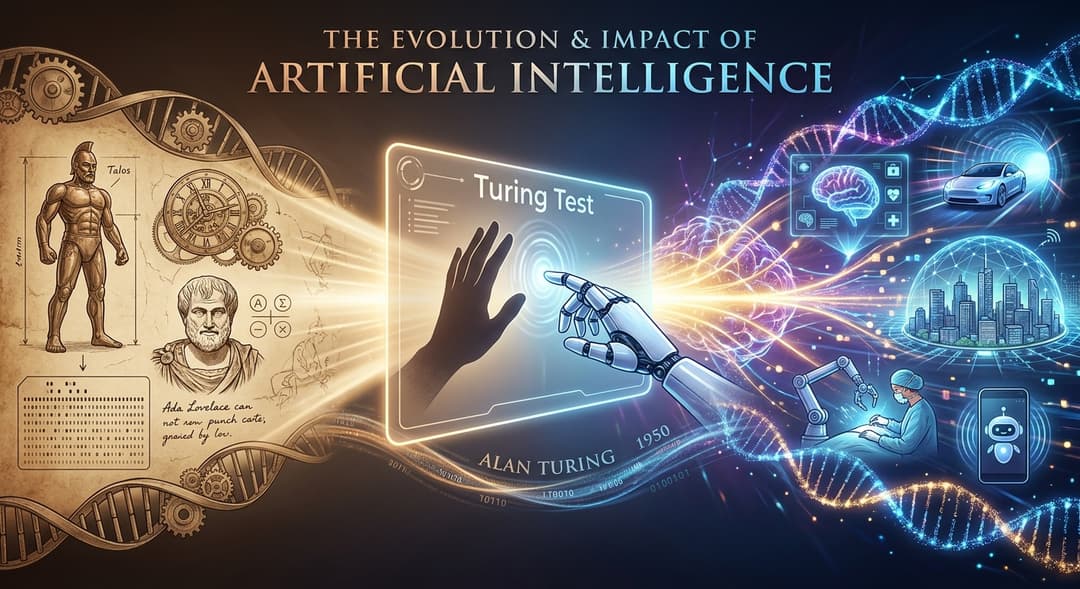
Generate a hero image prompt that visually represents the core message of the draft.. Context: - Draft: The History and Impact of Artificial Intelligence

I. Introduction
    A. Definition of AI
        Artificial Intelligence (AI) refers to the simulation of human intelligence processes by machines, especially computer systems. These processes include learning (the acquisition of information and rules for using the information), reasoning (using rules to reach approximate or definite conclusions), and self-correction. More broadly, AI encompasses any technique that enables computers to mimic human intelligence, including problem-solving, recognition, and language understanding.

    B. Brief overview of AI's significance today
        Today, AI is not merely a futuristic concept but a pervasive force shaping nearly every aspect of modern life. From personalized recommendations on streaming platforms to sophisticated medical diagnostics, and from autonomous vehicles to virtual assistants, AI technologies are deeply embedded in our daily routines. It has become an indispensable tool for innovation across industries, driving efficiency, creating new possibilities, and fundamentally altering the landscape of work and leisure.

    C. Thesis statement: AI has evolved dramatically, continuously reshaping technology, society, and human capabilities.
        From its nascent theoretical musings to its current state of advanced deep learning, Artificial Intelligence has undergone a remarkable evolution. This journey has not only revolutionized technological capabilities but has profoundly reshaped societal structures and expanded the very boundaries of human potential, continually posing new opportunities and complex challenges.

II. Early Concepts and Foundations (Pre-1950s)
    A. Philosophical roots (ancient Greece, automatons)
        The fundamental ideas underpinning AI can be traced back to antiquity. Ancient Greek myths, such as those of Talos, a bronze automaton protector, reflect humanity's long-standing fascination with the creation of artificial beings exhibiting intelligence or autonomy. Philosophers like Aristotle explored the principles of logic and reasoning, laying groundwork for symbolic manipulation that would much later become crucial in AI. The mechanical automatons of various periods, like the elaborate clocks and moving figures constructed in medieval Europe and renaissance, further demonstrate this enduring human desire to imbue inanimate objects with lifelike properties and intelligent behaviors.

    B. Early mathematical and logical groundwork (Boole, Turing)
        The 19th and early 20th centuries saw significant intellectual breakthroughs that provided the necessary mathematical and logical frameworks for AI. George Boole’s development of Boolean algebra in the mid-19th century provided a symbolic logic system capable of representing true/false values and logical operations, forming the bedrock of computer science and digital circuits. Later, in the 1930s and 40s, Alan Turing's theoretical work on computability, particularly his concept of the "Turing Machine," established the theoretical limits of computation and laid out the blueprint for what a general-purpose computer could accomplish. His influential paper "Computing Machinery and Intelligence" (1950) introduced the "Imitation Game" (later known as the Turing Test), proposing a method for determining if a machine could exhibit intelligent behavior indistinguishable from a human.

    C. Visionary thinkers (e.g., Ada Lovelace's ideas on analytical engine programming)
        Even earlier, in the mid-19th century, Ada Lovelace, while working on Charles Babbage's Analytical Engine, articulated visionary concepts that foreshadowed modern computer programming and AI. She recognized that the machine could do more than just pure calculation; it could manipulate symbols according to rules, potentially creating music or art. Lovelace's insights into the engine's capability for processing symbolic logic, and not just numbers, represent an early understanding of
Y

AI image by yungeksani

125d ago
Prompt

Generate a hero image prompt that visually represents the core message of the draft.. Context: - Draft: The History and Impact of Artificial Intelligence I. Introduction A. Definition of AI Artificial Intelligence (AI) refers to the simulation of human intelligence processes by machines, especially computer systems. These processes include learning (the acquisition of information and rules for using the information), reasoning (using rules to reach approximate or definite conclusions), and self-correction. More broadly, AI encompasses any technique that enables computers to mimic human intelligence, including problem-solving, recognition, and language understanding. B. Brief overview of AI's significance today Today, AI is not merely a futuristic concept but a pervasive force shaping nearly every aspect of modern life. From personalized recommendations on streaming platforms to sophisticated medical diagnostics, and from autonomous vehicles to virtual assistants, AI technologies are deeply embedded in our daily routines. It has become an indispensable tool for innovation across industries, driving efficiency, creating new possibilities, and fundamentally altering the landscape of work and leisure. C. Thesis statement: AI has evolved dramatically, continuously reshaping technology, society, and human capabilities. From its nascent theoretical musings to its current state of advanced deep learning, Artificial Intelligence has undergone a remarkable evolution. This journey has not only revolutionized technological capabilities but has profoundly reshaped societal structures and expanded the very boundaries of human potential, continually posing new opportunities and complex challenges. II. Early Concepts and Foundations (Pre-1950s) A. Philosophical roots (ancient Greece, automatons) The fundamental ideas underpinning AI can be traced back to antiquity. Ancient Greek myths, such as those of Talos, a bronze automaton protector, reflect humanity's long-standing fascination with the creation of artificial beings exhibiting intelligence or autonomy. Philosophers like Aristotle explored the principles of logic and reasoning, laying groundwork for symbolic manipulation that would much later become crucial in AI. The mechanical automatons of various periods, like the elaborate clocks and moving figures constructed in medieval Europe and renaissance, further demonstrate this enduring human desire to imbue inanimate objects with lifelike properties and intelligent behaviors. B. Early mathematical and logical groundwork (Boole, Turing) The 19th and early 20th centuries saw significant intellectual breakthroughs that provided the necessary mathematical and logical frameworks for AI. George Boole’s development of Boolean algebra in the mid-19th century provided a symbolic logic system capable of representing true/false values and logical operations, forming the bedrock of computer science and digital circuits. Later, in the 1930s and 40s, Alan Turing's theoretical work on computability, particularly his concept of the "Turing Machine," established the theoretical limits of computation and laid out the blueprint for what a general-purpose computer could accomplish. His influential paper "Computing Machinery and Intelligence" (1950) introduced the "Imitation Game" (later known as the Turing Test), proposing a method for determining if a machine could exhibit intelligent behavior indistinguishable from a human. C. Visionary thinkers (e.g., Ada Lovelace's ideas on analytical engine programming) Even earlier, in the mid-19th century, Ada Lovelace, while working on Charles Babbage's Analytical Engine, articulated visionary concepts that foreshadowed modern computer programming and AI. She recognized that the machine could do more than just pure calculation; it could manipulate symbols according to rules, potentially creating music or art. Lovelace's insights into the engine's capability for processing symbolic logic, and not just numbers, represent an early understanding of

gemini-3-pro-image-previewimage
0
Actions
Share to

Create AI Art Like This

Generate stunning images and videos with AI — on your own keys, no markup

Get Started